To spread the original, universal and eternal truth, path or law of yoga, which remains forever the same in essence, yet always adapts to the time and place.
|
To spread the original, universal and eternal truth, path or law of yoga, which remains forever the same in essence, yet always adapts to the time and place. |
|
|
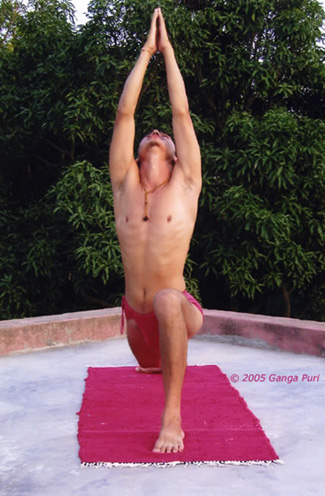
In the indian tradition, Hatha Yoga is one of the four main traditions of Tantra Yoga. Hatha Yoga is first of all concentrating on the practice of postures (asanas) and breath control (pranayama) to energize the subtle channels (nadis). Thus one might say Hatha Yoga concentrates on the third and fourth steps of the eight-fold path of Ashtanga Yoga. The objective of Hatha Yoga is obviously to remove the obstacles to address the further steps of Pratyahara (sense-withdrawal), Dharana (Concentration), Dhyana (Meditation) and Samadhi (Balance). In many Hatha Yoga schools, these further steps are seen as part of Hatha Yoga. What's in a name ? Excercising postures or Asanas in Hatha Yoga has two essential objectives. The first is that to practice any real meditation, one needs at the least one posture in which one can be perfectly comfortable for a longer period of time. The more such postures one can master, the better the basis for developing the inner meditation techniques. The second objective of excercising asanas in Hatha Yoga is to bring health and energy to body and mind by opening the nadis. When such excercises are regularly perfomed, the path of hatha yoga is opened automatically, though one still has to follow it further. The mere mastering of postures is no objective in itself, though mastering various postures certainly strengthens the power of will and concentration and the habit of not paying too much attention to the information input by the senses. Thus practicing asanas in Hatha Yoga directly opens the path to Prathyahara and Dharana. The excercise of Pranayama in Hatha Yoga is essential to master ones' breathing patterns. If one can master breath, then the mastery of mind is within reach. Through breathing excercises the flow of prana or vital life force through the body is regulated. That energy is certainly needed on the further steps of Hatha Yoga that ultimately may lead to samadhi. Special breathing techniques, in which the flow of breath though both nostrils is alternated, brings balance to the two hemispheres of the brain. Pranayama in Hatha Yoga also activates the Kundalini Energy. So Hatha Yoga is a very good place to start on the path of yoga. And even then it is important to realize that if the first 2 steps of Ashtanga Yoga are neglected, Yama and Niyama, Hatha Yoga might not bring the desired results. Even simple Hatha Yoga excercises should be avoided for example if you have not been properly gone to the toilet. Hatha Yoga comes in many varieties and traditions, such as Kashmir Yoga, Iyengar Yoga, Ashtanga Vinyasa Yoga, etc.. In traditional schools, often some of the following categories of Hatha Yoga practice are used to optimally respond to the needs and objectives of the Hatha Yoga practicioner :
Combinations of these 6 practices are also possible of course and many yoga schools have developed other practices. |
|
|
Related video : Full Class - The role of Asana in Ashtanga Yoga (80')
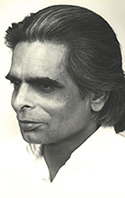 Sanatan Society is an international networking association of students of the late Harish Johari, joining efforts to promote his teachings of yoga philosophy, tantra, worship, art and love. Sanatan Society stands
for the original, universal and eternal truth, path or law of yoga.
Though it is Hindu in origin, Sanatan Society is not limited to any religion,
race, time or country, nor in fact to any particular organisation. More about Sanatan Society...
Sanatan Society is an international networking association of students of the late Harish Johari, joining efforts to promote his teachings of yoga philosophy, tantra, worship, art and love. Sanatan Society stands
for the original, universal and eternal truth, path or law of yoga.
Though it is Hindu in origin, Sanatan Society is not limited to any religion,
race, time or country, nor in fact to any particular organisation. More about Sanatan Society...




 The above overview on
Hatha Yoga was extracted and synthesized by
The above overview on
Hatha Yoga was extracted and synthesized by